Brother Bluebell, Brother Bird and Sister Deer

Over half of the world’s bluebells are to be found in the UK, I recently learned, so it is very special indeed when these beautiful flowers come into bloom in April/May.

Bluebells, in Ercall Wood, Shropshire, April 2022

When seen in abundance, as in this photo, I’m sure you’ll agree they are breath-taking!

And you might be wondering why “Brother Bluebell”… It’s a reference to Francis of Assisi’s beautiful poem sometimes known as “The Canticle of the Sun”, where he praises “Brother Sun”, “Sister Moon”, and so on. He feels a kinship with the natural world.

And there’s something like that sense of kinship when your heart beats a bit faster, on seeing bluebells, or suddenly coming across wild deer (they had retreated to the top of the field in this photograph…

…but as I continued through the wood I had a much closer encounter!…)

And at the end of this day’s walk, I was delighted by another tiny goldcrest (see the post ‘Grateful for a Little Thing’ for the last time I encountered one of these, here )

And also a nuthatch…

…who went on, true to its name, to “hack” (“hatch”) a nut into the bark of the tree – this photo captures the moment when the nut was still in the beak…

Our kinship with flora and fauna is precious indeed.

I hope you are inspired to get out and seek some brothers and sisters of your own!

If you live in Shropshire, parking for this walk is beyond the main Wrekin car park, driving away from Wellington. Pull in by a barrier, head off left through the bluebells and follow path up. When you eventually walk alongside the golf course, look out for a path up the bank to the right after 100m or so, then go left at the junction (i.e. not down into the valley), which will take you round to the right eventually where get glimpses of the open field where the deer were. Keep following the path through the wood, then, eventually, right again at a T junction to take you down the hill and back to the road to where you parked.

Local Beauties

It’s easy to miss the everyday wonders.

Small brown birds are so common in the UK (and perhaps beyond!) that many birdwatchers call them “LBJs” (“little brown jobs”!), but on a recent early walk around the Rea Brook in Shrewsbury, the sweetness of this drab dunnock caught my attention, and he was so busy singing he let me capture his plain beauty:

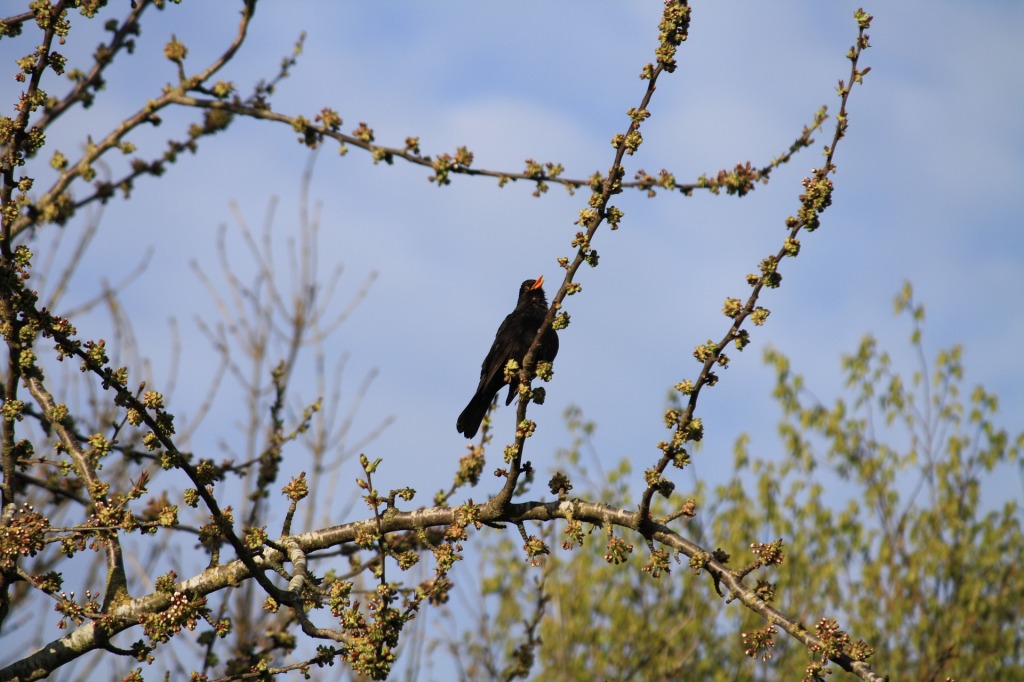
Everyone knows a blackbird, but their song can be so magical in the dawn stillness, empty of all human noise. This one was really pouring out his heart!

And finally, the humble woodpigeon. They look chubby, comical, and are easily dismissed as common-all-garden – and yet the rays of the sun highlighted the iridiscence on this bird’s neck as it sat beautifully framed in spring blossom:

What are your local beauties?

Or do you need to go looking and listening with fresh eyes and ears?

A Richness of Wildlife

The Severn is so rewarding in its richness of wildlife and flora.

I love to spy on the shy herons and goosander, though often they see you first!

Goosanders are not widely known about. The female looks bright white in the sun with a beautiful green head, whereas the male has a very different chestnut-red head, more flattened and “swept back” than the rounded head of his mate.

(You can read a previous post about the birds of the River Severn here)

On this spring afternoon I was also blessed by the surprising sight of bees feeding in the riverside trees….

…and three different species of butterflies: tortoisehell, peacock and comma. The upside-down peacock really does give the impression of a strange owl-like creature with wide eyes!

Mute swans and Canada geese congregate on the banks as well as in the river itself, and both are stunning to watch in flight.

(You can read a previous post about geese on the River Severn and a beautiful poem by Mary Oliver here).

On my return, I nearly failed to photograph some long-tailed tits, but followed the wise naturalists’ advice: stay still and you have a 50% chance they will move towards you. On this occasion they did!

Don’t forget to check the dead tree near the start and finish: cormorants like to perch here picturesquely sometimes, their silhouettes haunting against a Shropshire sky (there weren’t any today!).

~

Parking for this walk is in the ‘I Love Plants’ car park. Cross the busy road carefully and walk right for a very short while, then over a well-hidden stile on the left, and down across the field, turning right at the river. The walk soon goes through the outskirts of a farm but then you are out into peaceful fields. If you go with others who also have a car, you can make this a linear walk, leaving one car at Atcham, though note that as of March 2022 a bridge over a ditch has been washed away in the winter flood, and you have to detour away from the river and around a hedge in order to reach the road near Atcham. You can also turn left at the river at the start and walk up towards Monkmoor, also along the river, but I find the section from I Love Plants to Atcham is the more peaceful and rewarding as it takes you further out of town rather than toward residential areas. Walking to the ditch and back is a very satisfying walk of 45mins-1 hour, and is dog-friendly.

A Robin at Wroxeter

Wroxeter is a beautiful place.

There are the remains of the Roman city, of course, so picturesquely situated within sight of the Wrekin, the Lawley and Caer Caradoc.

There is the beautiful village, with the church partly built using stone from the Roman city, and also from Haughmond Abbey.

When I visited recently a robin perched in the February sunshine for me as I wandered in the peace of the early morning…

~

A robin sang

from the branches of a winter tree

~

His belly was as bright as the day

his breast red as the sunset

~

Gracing my winter spirit

with tones of happiness.

~

Robin, Wroxeter, February 2022

Tones of Happiness – for National Robin Day

National Robin Day is an annual nationwide event raising awareness of small birds and other wildlife in winter and how we can help them through this tough time of year...The cold winter months are especially tough for animals; as temperatures drop and food becomes scarce, wildlife such as garden birds need a little extra help.” Visit https://www.nationalrobinday.co.uk/ to find out more!

~

A robin sang

from the branches of a winter tree

~

His belly was as bright as the day

his breast red as the sunset

~

Gracing my winter spirit

with tones of happiness.

~

Robin, Shrewsbury, Autumn 2021