The daffodils arrive
Trumpeting the spring
And the singing
Of the song thrush
All life
Is here
In the colour
And movement
And the music
That I hear.
~
Photograph: daffodils, Morchard Bishop, January 2025

Words and Thoughts, for Life

The daffodils arrive
Trumpeting the spring
And the singing
Of the song thrush
All life
Is here
In the colour
And movement
And the music
That I hear.
~
Photograph: daffodils, Morchard Bishop, January 2025

The pure white face of a lamb stared at me in wonder in the spring sunshine as I reached the top of The Burway, Shropshire’s highest public road…

April on The Long Mynd changed from bleak to beautiful.
On a subsequent visit, I came across more four-footed friends posing dramatically…


Now I was the one staring in wonder.
To be amongst such beautiful company was nothing but blessing.

How do you describe the outburst of greens, yellows, blues and other colours in the spring?
Mary Oliver said this:
“The vivacity of ‘what was’ is married
to the vitality of ‘what will be’…”
from ‘Lines Written in the Days of Growing Darkness’ by Mary Oliver
And I’ve come across two beautiful phrases by Emily Dickinson in the last few weeks that also seek to capture the magic of spring:
“…experiment in green”
from ‘A Little Madness in the Spring’ (available to read here)
…and…
“express from God”
from ‘Spring is the Period’ (available to read here)
I hope they have inspired you!
This photograph, simply of a bud on a tree, was taken at Dudmaston, in Shropshire, where the bluebells were out early in April.
It certainly looked like “vitality“, an “experiment in green” and “express from God” to me!


It’s easy to miss the everyday wonders.
Small brown birds are so common in the UK (and perhaps beyond!) that many birdwatchers call them “LBJs” (“little brown jobs”!), but on a recent early walk around the Rea Brook in Shrewsbury, the sweetness of this drab dunnock caught my attention, and he was so busy singing he let me capture his plain beauty:

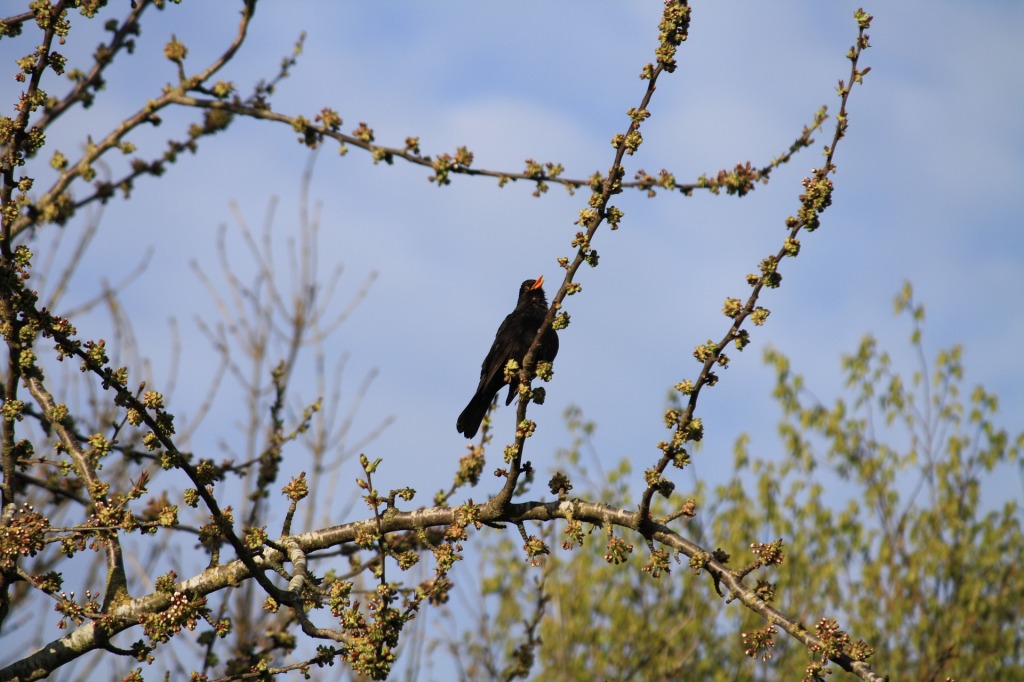
Everyone knows a blackbird, but their song can be so magical in the dawn stillness, empty of all human noise. This one was really pouring out his heart!
And finally, the humble woodpigeon. They look chubby, comical, and are easily dismissed as common-all-garden – and yet the rays of the sun highlighted the iridiscence on this bird’s neck as it sat beautifully framed in spring blossom:

What are your local beauties?
Or do you need to go looking and listening with fresh eyes and ears?
David Steindl-Rast is not a well-known writer in the UK but his book Gratefulness is the best I’ve read on this topic. He shares a childhood experience, surviving bombing raids in Nazi-occupied Austria:
“…Unable to find an air-raid shelter quickly, I rushed into a church only a few steps away. To shield myself from shattered glass and falling debris, I crawled under a pew … I felt sure that the vaulted ceiling would cave in any moment and bury me alive…A steady tone of the siren announced the danger was over … And there I was, stepping out into a glorious May morning … My eyes fell on a few square feet of lawn in the midst of all this destruction. It was as if a friend had offered me an emerald in the hollow of his hand. Never before or after have I seen grass so surprisingly green.”
p.10
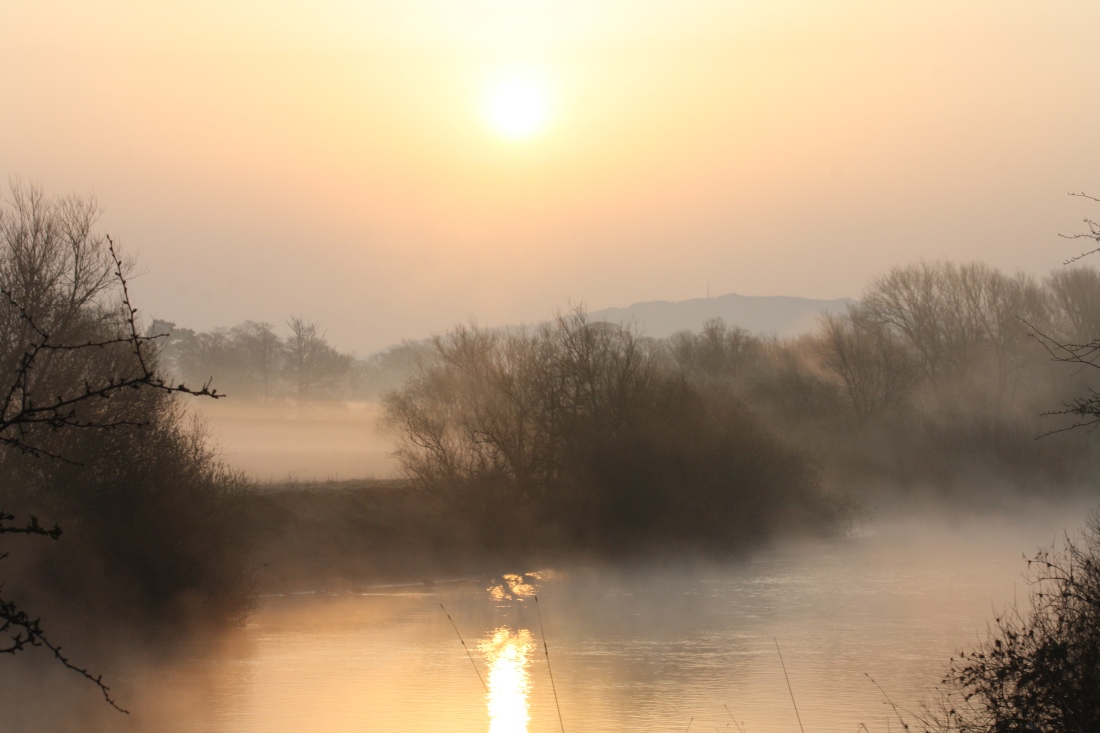
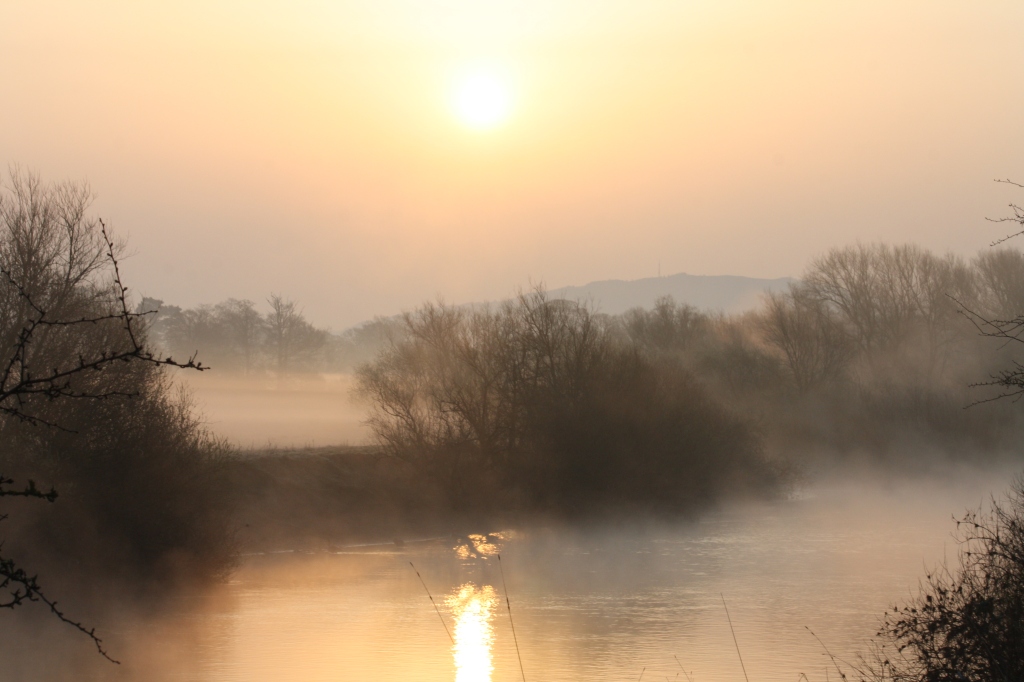
Recently I was commuting to work on a quiet spring morning, and I passed the most extraordinary scene shown in the photograph. You do not always need a near-death experience to feel gratitude! But how many people drove out of Shrewsbury that morning and did not stop to gaze in awe at the sunrise?
Mist was rolling mysteriously down the river. The trees were silhouetted. And a bright March sun illuminated the whole scene, rising over The Wrekin.
Brother David Stendl-Rast helped to set up a beautiful website devoted to gratefulness, and you can visit it here.
And look out for those surprising moments that fill our hearts with gratitude!

For years, I didn’t know about celandines. And yet at this time of year, in March, they are everywhere in Shropshire, tiny treasures of sunlight-yellow, joyfully announcing the spring.
The poet William Wordsworth wrote about these beautiful gems:
There is a Flower, the Lesser Celandine,
That shrinks, like many more, from cold and rain;
And, the first moment that the sun may shine,
Bright as the sun himself, ’tis out again!
Fittingly, he himself was born in the spring, 7th April 1770.
The photograph is of a patch of celandines on the banks of the River Severn – the sunlight bringing out the beautiful blues, greens and yellows.
Keep your eyes open for them!


It’s the daffodil time of year in the UK – that wonderful, brief time, when yellows trumpet at us from every patch of green around. And especially so in Shropshire.
Shakespeare wrote about the daffodils…
“…that come before the swallow dares
And take the winds of March with beauty”
from ‘A Winter’s Tale’
And of course Wordsworth once wandered…
“…lonely as a cloud
That floats on high o’er vales and hills
When all at once I saw a crowd
A host of golden daffodils…”
The photograph is of the entrance to Attingham Park, Shropshire, taken from the other side of the road in Atcham, where the daffodils are looking as beautiful as they always do every year.
Truly a gateway of golden daffodils to the spring!


Mary Oliver’s poetry celebrates the wonders of nature, and I love this poem by hers, called “Whistling Swans”. Here are some of its wonderful lines:
“Even when the swans are flying north and making
such a ruckus of noise, God is surely listening and understanding.
Rumi said, There is no proof of the soul.
But isn’t the return of the spring and how it
springs up in our hearts a pretty good hint?”
from “Whistling Swans” by Mary Oliver
I recently witnessed – not whistling swans – but geese, making “such a ruckus of noise” at Polemere nature reserve, just off the Pontesbury Road. There was also a huge flock of lapwing, who displayed themselves both in the air and on the ground.

Spring is definitely returning, and springing up in hearts in Shropshire, as snowdrops and even daffodils are starting to appear.

I hope that either nature, or Mary Oliver’s lines, will make something spring up in your heart by the time you have finished reading this post.

Greylag geese in flight, Polemere nature reserve, Shropshire, February 2022

Mary Oliver’s poetry celebrates the wonders of nature, and I love this poem by hers, called “Whistling Swans”. Here are some of its wonderful lines:
“Even when the swans are flying north and making
such a ruckus of noise, God is surely listening and understanding.
Rumi said, There is no proof of the soul.
But isn’t the return of the spring and how it
springs up in our hearts a pretty good hint?”
from “Whistling Swans” by Mary Oliver
I recently witnessed – not whistling swans – but geese, making “such a ruckus of noise”.
And spring is definitely returning, and springing up in hearts in Shropshire…
I hope that either nature, or Mary Oliver’s lines, will make something spring up in your heart by the time you have finished reading this post.
Greylag geese in flight, Polemere nature reserve, Shropshire, February 2022

Celtic spring (“Imbolc”) began this week, on February 1st, and light is slowly beginning to fight back against the predominance of darkness.
I recently photographed this beautiful sunrise at Wroxeter Roman city, and some words by the poet Mary Oliver – “darkness opening into morning is enough” – inspired this short poem:
~
The magic
Of the darkness
~
Of the morning
Transfigured
~
Into lightIs enough.
~

 Lif4Gd