Out walking around Dudmaston in Shropshire I met this beautiful group of geese. It’s not such an unusual sight around the River Severn, but the way they were framed by the colours of autumn made more beautiful by the warm afternoon sun made it a lovely moment.
There’s a lot to be said for just being and enjoying the beauty of autumn when we have the opportunity!
Small brown birds are so common in the UK (and perhaps beyond!) that many birdwatchers call them “LBJs” (“little brown jobs”!), but on a recent early walk around the Rea Brook in Shrewsbury, the sweetness of this drab dunnock caught my attention, and he was so busy singing he let me capture his plain beauty:
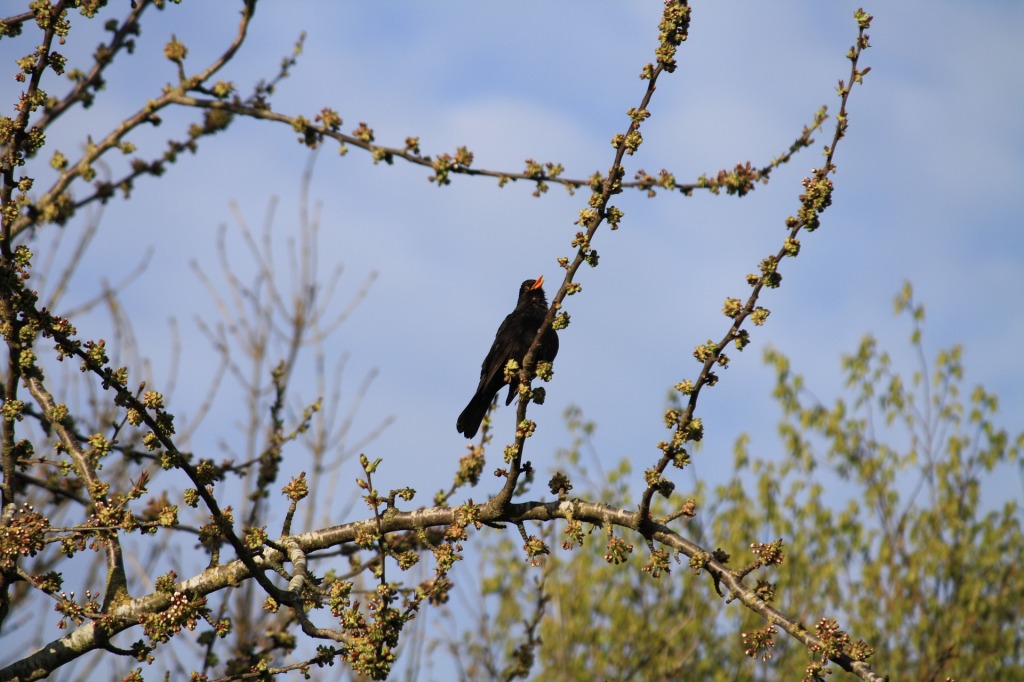
Everyone knows a blackbird, but their song can be so magical in the dawn stillness, empty of all human noise. This one was really pouring out his heart!
And finally, the humble woodpigeon. They look chubby, comical, and are easily dismissed as common-all-garden – and yet the rays of the sun highlighted the iridiscence on this bird’s neck as it sat beautifully framed in spring blossom:
What are your local beauties?
Or do you need to go looking and listening with fresh eyes and ears?
How often do we stop and simply look and appreciate what is all around us?
I recently stopped on my commute and took some photographs of a most beautiful sunset in the village of Atcham in Shropshire.
In many ways it was an ordinary sunset, if there is such a thing as an ordinary sunset!
But when you take photographs, it does make you pay more than usual attention to composition, shapes and colours. And the more I looked, the more I noticed.
Not only were the clouds such beautiful, changing hues of orange, red and grey, but many were also, as in the photograph, reflected beautifully in the stillness of the Severn, where I could also see the perfect reflected silhouettes of trees.
It was a very memorable few minutes.
And it reminded me of the power of how good it is to be deliberately mindful in the way we use our amazing sense of sight.
It’s a very worthwhile exercise just to take a few moments every day to look mindfully at our surroundings. Really loook at details, shapes, colours. See what you notice! See if you, too, are sometimes inspired!
The other day it was raining in Shrewsbury, and I as I approached my bedroom window my eye was caught by something extraordinary.
Not by the view over the houses on the other side of the street towards the trees of the nearby nature reserve of Rea Brook, not by the dismal grey skies, but by the tiny water droplets clinging to the window pane.
Each was “alittle world made cunningly“.
This wonderful phrase comes from a poem by John Donne which begins like this:
I am a little world made cunningly Of elements and an angelic sprite
John Donne, ‘Holy Sonnets’
John Donne saw in himself “a little world”, a worthy, valuable existence, an existence with the potential for good. He saw in himself “sprite” (not the fizzy drink!) – we would say “spirit” today. It is true that he also saw in himself conflict, and if you are interested in this, you can read the whole poem here.
In each raindrop, I saw the same image of the road reflected, each time in a slightly different way. It was like an infinity of different perspectives that infinitely expanded the view from my own eyes.
A day that had appeared so grey and empty of interest suddenly seized me with interest. I lived in a “world made cunningly“.
Wouldn’t life be good if we could adopt this vision of John Donne’s more frequently, and see “a little world made cunningly” in everyone we meet and in everything we see?
My weekday commute is about 45 minutes. I drive past the amazing Wrekin in Shropshire (“the little mountain with many secrets” every day (you can see what it looks like here .
But more importantly, the commuting journey is a time when the brain is somehow set free to wander, think, create, remember, explore…perhaps with the help of music playing in the background.
Perhaps this is an analogy for meditation?
.
T.S. Eliot wrote:
“At the still point of the turning world
There the dance is
Neither movement from
nor towards
There is only the
dance
I can only say, there
we have been but I cannot say where




 Lif4Gd