I have always loved to watch kestrels and their amazing ability to hover in the air. On a recent visit to Bettisford Moss, a visiting kestrel was a highlight, and this poem I wrote was inspired by another poem about a kestrel by Gerard Manley Hopkins, called ‘The Windhover’, which you can read here.
~
I caught that day
In his hovering over
~
Of the stillness lake
And my heart stirred
~
Simply for that bird
In flight
~
As if suddenly
I had joined
~
His light
Motion and unceasing
~
Trembling of the steady air
All captured
~
In moments
Of enraptured stare.
~
Bettisford Moss itself has a bleak beauty, with the occasional shrub and pond adding some variety to the landscape:
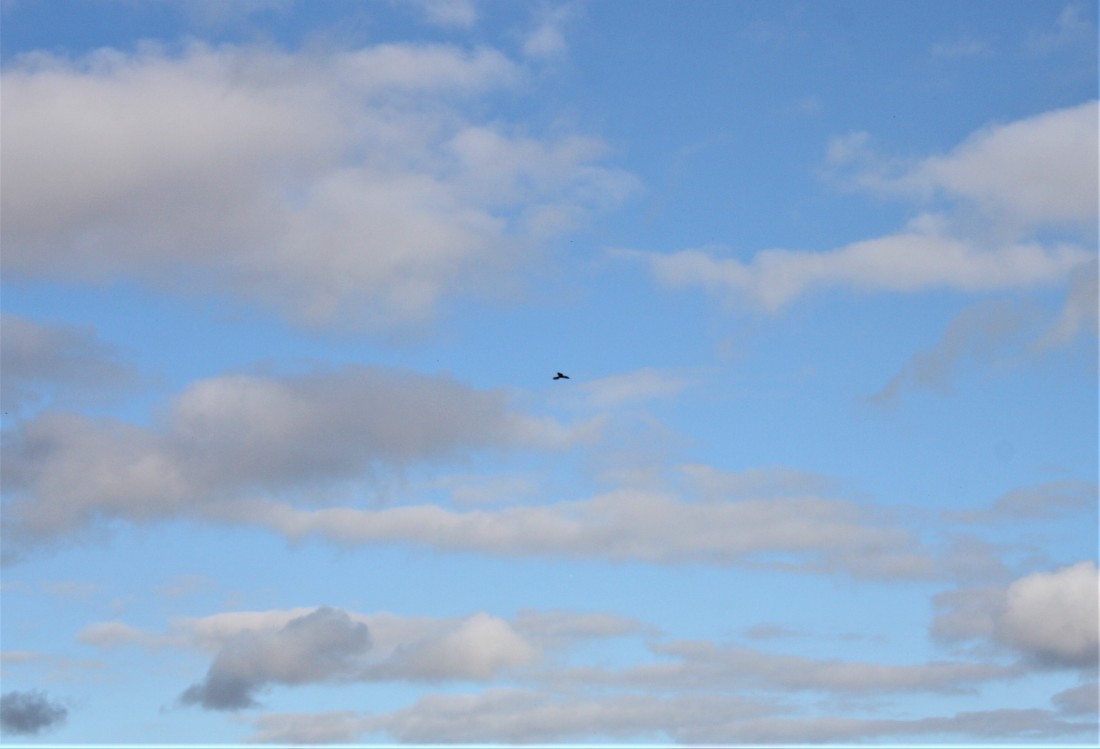
I was only able to capture a rather distant of that day’s kestrel:
Gerard Manley Hopkins describes a kestrel (also known as a “windhover”) so well…
“…in his riding Of the rolling level underneath him steady air, and striding High there, how he rung upon the rein of a wimpling wing In his ecstasy! then off, off forth on swing, As a skate’s heel sweeps smooth on a bow-bend: the hurl and gliding Rebuffed the big wind. My heart in hiding Stirred for a bird, – the achieve of, the mastery of the thing!”
from ‘The Windhover’
This kestrel was hunting around the quarry in Bayston Hill, just outside Shrewsbury in Shropshire, UK, living its own life of wildness and survival.
My feet were firmly fixed to the earth; the kestrel was “striding high” in the air. And my “heart in hiding” also “stirred for a bird”.
What takes you beyond your own concerns, beyond your own feeling, beyond your own life?
For me, once it was simply watching a bird of prey hovering over a reservoir where I had been taken as a child. The bird was a kestrel (see image above), which I knew from an interest I had developed in ornithology, and I was amazed at the way its wings seem to ripple and tremble as it hung in the air, as if magically suspended.
I was transported out of my own self-pity and gloom into a fascination with one of nature’s mysteries. I was taken beyond, into a life beyond my own, a life beyond even human life.
Later in life, I came across this poem, also about a kestrel, by Gerard Manley Hopkins, called “The Windhover” (another name for a kestrel).
It’s not an easy poem to understand at first reading, but I was captivated by the play that Hopkins makes with sounds. You really do need to read the poem out loud (even if quietly!) to hear all the echoes and rhyming sounds. And it is a poem about what is beyond, about revelation.
Hopkins was a Jesuit, and for him the beauty of the bird is a revelation to his heart – a revelation of God, who is “a billion times told lovelier”. He describes the “fire” that “breaks” from God – the fire of the Spirit, the energies of God.
A bird took him, and me, beyond. What takes you beyond?
Here is the full poem:
I caught this morning morning’s minion, king- dom of daylight’s dauphin, dapple-dawn-drawn Falcon, in his riding Of the rolling level underneath him steady air, and striding High there, how he rung upon the rein of a wimpling wing In his ecstacy! then off, off forth on swing, As a skate’s heel sweeps smooth on a bow-bend: the hurl and gliding Rebuffed the big wind. My heart in hiding Stirred for a bird,—the achieve of, the mastery of the thing!
Brute beauty and valour and act, oh, air, pride, plume, here Buckle! and the fire that breaks from thee then, a billion Times told lovelier, more dangerous, O my chevalier!
No wonder of it: shéer plód makes plough down sillion Shine, and blue-bleak embers, ah my dear, Fall, gall themselves, and gash gold-vermillion.
Are you ever drawn to natural, wild, wilderness places? This post was inspired by a line in a poem by Gerard Manley Hopkins – “Long live the weeds and the wilderness yet” – and also by a surprising natural encounter I had recently.
Hopkins’ poem celebrates wild natural beauty but is quite a challenging read because of the way he likes to use unusual words and unusual syntax. If you want to read it, I suggest you just let the bits you don’t follow just “wash over you” and just enjoy the general impression of the wonderful way he uses words…
THIS darksome burn, horseback brown,
His rollrock highroad roaring down,
In coop and in comb the fleece of his foam
Flutes and low to the lake falls home.
.
A windpuff-bonnet of fáwn-fróth
Turns and twindles over the broth
Of a pool so pitchblack, féll-frówning,
It rounds and rounds Despair to drowning.
.
Degged with dew, dappled with dew
Are the groins of the braes that the brook treads through,
Wiry heathpacks, flitches of fern,
And the beadbonny ash that sits over the burn.
.
What would the world be, once bereft
Of wet and of wildness? Let them be left,
O let them be left, wildness and wet;
Long live the weeds and the wilderness yet.
.
For me, Lif4Gdinvolves feeling connected with nature. In Shropshire, where I live, the wilderness is never far away, and is part of what makes life good:
The wild birds inhabit these hills
and I, a
walker,
glancing down the valley
dazzled by
gleaming lights
flung
across the fields like necklaces
I feel connected with the wind
the grass
under my feet
God’s sky above my head.
Yesterday as I was walking Rae Brook Nature Reserve in
Shrewsbury I spotted a dipper (these are usually mountain stream birds in the
UK) dancing around the edges of the Rae Brook.
“Long live the weeds and the wilderness yet” indeed. Nature is full of surprises and offers a deep
connection to humanity.
A dipper
Some Questions to
Ponder
Do you feel connected to, or separate from, nature? How could you get more connected?
What places of natural wildness and wilderness mean a lot to you? What have been some of your most surprising and memorable encounters of connection with nature?
By all means leave a comment if the post or the questions made you want to share your own thoughts.




 Lif4Gd