Mary Oliver’s poetry celebrates the wonders of nature, and I love this poem by hers, called “Whistling Swans”. Here are some of its wonderful lines:
“Even when the swans are flying north and making
such a ruckus of noise, God is surely listening and understanding.
Rumi said, There is no proof of the soul.
But isn’t the return of the spring and how it
springs up in our hearts a pretty good hint?”
from “Whistling Swans” by Mary Oliver
I recently witnessed – not whistling swans – but geese, making “such a ruckus of noise” at Polemere nature reserve, just off the Pontesbury Road. There was also a huge flock of lapwing, who displayed themselves both in the air and on the ground.
Spring is definitely returning, and springing up in hearts in Shropshire, as snowdrops and even daffodils are starting to appear.
I hope that either nature, or Mary Oliver’s lines, will make something spring up in your heart by the time you have finished reading this post.
Greylag geese in flight, Polemere nature reserve, Shropshire, February 2022
“National Robin Day is an annual nationwide event raising awareness of small birds and other wildlife in winter and how we can help them through this tough time of year...The cold winter months are especially tough for animals; as temperatures drop and food becomes scarce, wildlife such as garden birds need a little extra help.” Visit https://www.nationalrobinday.co.uk/ to find out more!
Gerard Manley Hopkins describes a kestrel (also known as a “windhover”) so well…
“…in his riding Of the rolling level underneath him steady air, and striding High there, how he rung upon the rein of a wimpling wing In his ecstasy! then off, off forth on swing, As a skate’s heel sweeps smooth on a bow-bend: the hurl and gliding Rebuffed the big wind. My heart in hiding Stirred for a bird, – the achieve of, the mastery of the thing!”
from ‘The Windhover’
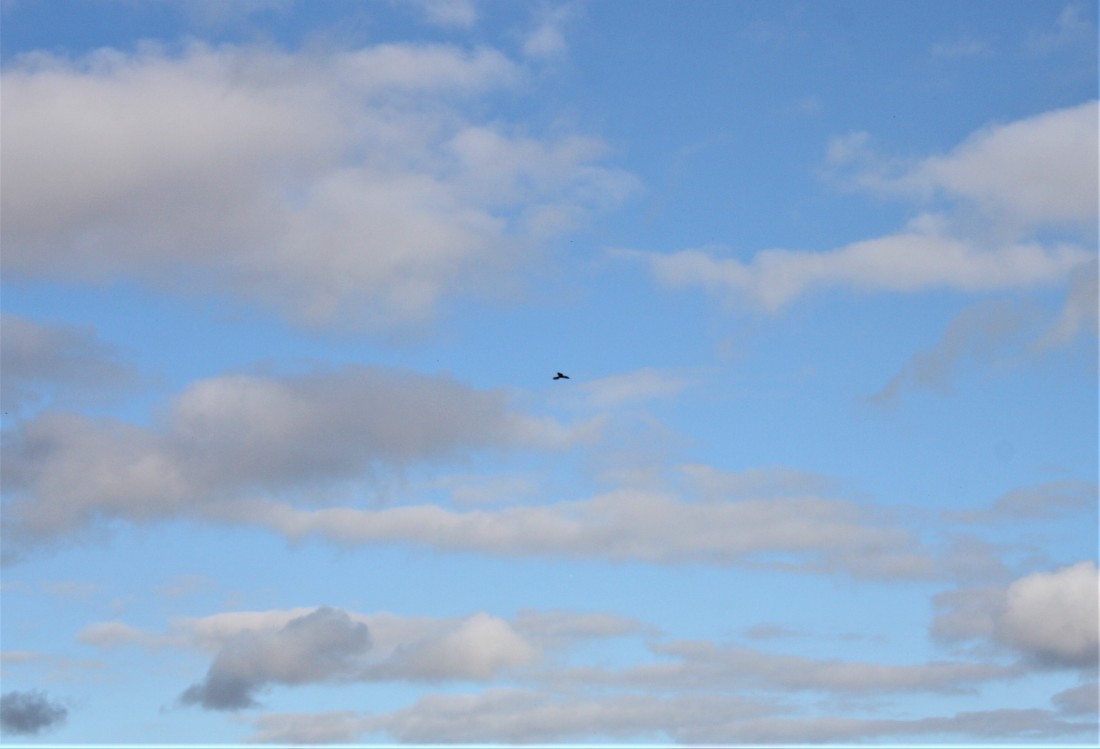
This kestrel was hunting around the quarry in Bayston Hill, just outside Shrewsbury in Shropshire, UK, living its own life of wildness and survival.
My feet were firmly fixed to the earth; the kestrel was “striding high” in the air. And my “heart in hiding” also “stirred for a bird”.
What takes you beyond your own concerns, beyond your own feeling, beyond your own life?
For me, once it was simply watching a bird of prey hovering over a reservoir where I had been taken as a child. The bird was a kestrel (see image above), which I knew from an interest I had developed in ornithology, and I was amazed at the way its wings seem to ripple and tremble as it hung in the air, as if magically suspended.
I was transported out of my own self-pity and gloom into a fascination with one of nature’s mysteries. I was taken beyond, into a life beyond my own, a life beyond even human life.
Later in life, I came across this poem, also about a kestrel, by Gerard Manley Hopkins, called “The Windhover” (another name for a kestrel).
It’s not an easy poem to understand at first reading, but I was captivated by the play that Hopkins makes with sounds. You really do need to read the poem out loud (even if quietly!) to hear all the echoes and rhyming sounds. And it is a poem about what is beyond, about revelation.
Hopkins was a Jesuit, and for him the beauty of the bird is a revelation to his heart – a revelation of God, who is “a billion times told lovelier”. He describes the “fire” that “breaks” from God – the fire of the Spirit, the energies of God.
A bird took him, and me, beyond. What takes you beyond?
Here is the full poem:
I caught this morning morning’s minion, king- dom of daylight’s dauphin, dapple-dawn-drawn Falcon, in his riding Of the rolling level underneath him steady air, and striding High there, how he rung upon the rein of a wimpling wing In his ecstacy! then off, off forth on swing, As a skate’s heel sweeps smooth on a bow-bend: the hurl and gliding Rebuffed the big wind. My heart in hiding Stirred for a bird,—the achieve of, the mastery of the thing!
Brute beauty and valour and act, oh, air, pride, plume, here Buckle! and the fire that breaks from thee then, a billion Times told lovelier, more dangerous, O my chevalier!
No wonder of it: shéer plód makes plough down sillion Shine, and blue-bleak embers, ah my dear, Fall, gall themselves, and gash gold-vermillion.
There’s a poem by Emily Dickinson which I love, which begins like this:
A Bird, came down the Walk – He did not know I saw – He bit an Angle Worm in halves And ate the fellow, raw
A few weekends ago in the UK, it was “The Big Garden Birdwatch”, organised by the Royal Society for the Protection of Birds (RSPB), and I was there, with thousands of others, eagerly waiting to see what would appear on a drizziliy and sleety January Saturday morning.
Every day the birds bless us with their presence. They come, without being asked, and fly overhead, or perch on a wall, or hop around the bushes.
I think Emily Dickinson, the nineteenth century American poet, also loved birds, because in another poem she describes Hope as a bird:
“Hope” is the thing with feathers – That perches in the soul – And sings the tune without the words – And never stops – at all –
It makes life good for me when I notice our beautiful bird life in around Shrewsbury. We see red kites, dippers, kingfishers…the list goes on.
Their gift of flight is something we can only achieve by technology. Emily Dickinson’s poem about birds ends with this beautiful description of flying:
Then he unrolled his feathers, And rowed him softer Home –
Than Oars divide the Ocean, Too silver for a seam
You can read the two poems referred to in this post by following these links:
There’s a great poem by Thomas Hardy called ‘The Darkling Thrush’, which I always think about in the darkness December and January, which ends like this:
At once a voice arose among
The bleak twigs overhead
In a full-hearted evensong
Of joy illimited;
An aged thrush, frail, gaunt, and small,
In blast-beruffled plume,
Had chosen thus to fling his soul
Upon the growing gloom.
~
So little cause for carolings
Of such ecstatic sound
Was written on terrestrial things
Afar or nigh around,
That I could think there trembled through
His happy good-night air
Some blessed Hope, whereof he knew
And I was unaware.
from ‘The Darkling Thrush’ by Thomas Hardy
Well, there can sometimes seem “so little cause…written on terrestrial things” for hope at the moment. And yet despite the darkness, even in the darkness, we still can find things to appreciate and enjoy.
Many psychologists recommend keeping a Gratitude Journal to help us focus on the good things in life. And maybe it makes Lif4Gd if we can manage to stay focused on moments of joy whilst also accepting the suffering around us.
See if you can notice a few things that bring you joy today. It’s a great discipline to try to find a few things every day.
If you would like to read the full version of Thomas Hardy’s poem, it is available here.




 Lif4Gd