I tread my way
This ordinary morning
Blessed by the stonechats
And the whitethroats’ song
It is a journey
Through successive
Revelations
Endlessly dawning.


Words and Thoughts, for Life

I tread my way
This ordinary morning
Blessed by the stonechats
And the whitethroats’ song
It is a journey
Through successive
Revelations
Endlessly dawning.

I have always loved to watch kestrels and their amazing ability to hover in the air. On a recent visit to Bettisford Moss, a visiting kestrel was a highlight, and this poem I wrote was inspired by another poem about a kestrel by Gerard Manley Hopkins, called ‘The Windhover’, which you can read here.
~
I caught that day
In his hovering over
~
Of the stillness lake
And my heart stirred
~
Simply for that bird
In flight
~
As if suddenly
I had joined
~
His light
Motion and unceasing
~
Trembling of the steady air
All captured
~
In moments
Of enraptured stare.
~
Bettisford Moss itself has a bleak beauty, with the occasional shrub and pond adding some variety to the landscape:


I was only able to capture a rather distant of that day’s kestrel:


It’s easy to miss the everyday wonders.
Small brown birds are so common in the UK (and perhaps beyond!) that many birdwatchers call them “LBJs” (“little brown jobs”!), but on a recent early walk around the Rea Brook in Shrewsbury, the sweetness of this drab dunnock caught my attention, and he was so busy singing he let me capture his plain beauty:

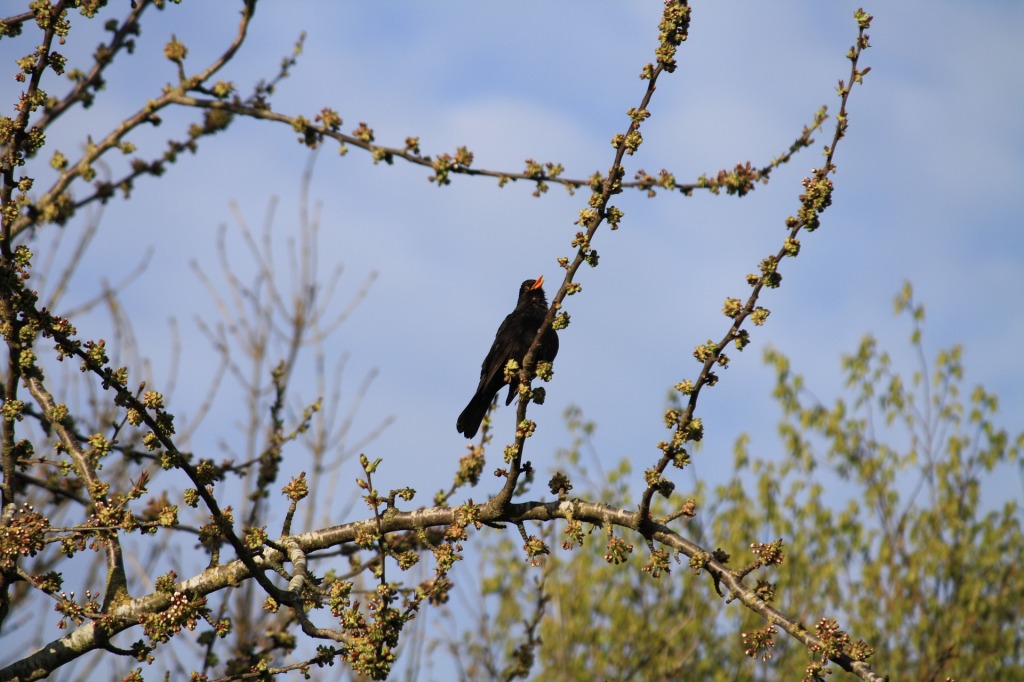
Everyone knows a blackbird, but their song can be so magical in the dawn stillness, empty of all human noise. This one was really pouring out his heart!
And finally, the humble woodpigeon. They look chubby, comical, and are easily dismissed as common-all-garden – and yet the rays of the sun highlighted the iridiscence on this bird’s neck as it sat beautifully framed in spring blossom:

What are your local beauties?
Or do you need to go looking and listening with fresh eyes and ears?

There is a beautiful poem by Mary Oliver about a time when her dog ran off, which ends:
“…who am I to summon his hard and happy body
his four white feet that love to wheel and pedal…
to come back to walk at my side, obedient.”
from ‘The Dog Has Run Off Again’
She recognises the wild, natural freedom that her dog loves – that is more precious than simply getting him to walk to heel!
I was down by the River Severn recently and saw some of my favourite colourful ducks there – goosanders. They are bright and beautiful, especially in the spring sunshine, but extremely shy. And as you can see from the photograph, it wasn’t long before they decided to assert their wild freedom, just like Mary Oliver’s dog!
And I had a similar thought. I do enjoy watching them and photographing them. But who am I to control their “one wild and precious life“?


I saw my first lapwing as a boy on a farm belonging to a family friend. It was a long way off, and all I remember is the tuft on its head. I remember thinking how magical it looked – especially to someone brought up in suburban London! It made my heart beat a little faster – the love affair had begun!
Decades later and I find myself in the Midlands, where, thankfully, lapwing are still not that uncommon.
In Shropshire, for example, I’ve discovered that they can fairly regularly be seen at Polemere Nature Reserve. In February, a huge flock were feeding in the field next to the reserve. When they decided to take off, they made a spectacular sight overhead:

This photo gives a closer view ofbirds strutting their stuff around the edge of the lake:

On a visit to Anglesey recently I had a much better view of the amazing, beautiful green breeding plumage of the male…

And this week I was treated to the wonderful spectacle of lapwings acrobatic, crazy flight and song, just over the Shropshire border in Staffordshire, as they chased, and were chased by, corvids, gulls and each other!


Their name lapwing may derive from the Anglo Saxon word for “leap” and “reel”, and as they displayed, I could see why!


Hopefully I’ll be able to write a follow up post once I’ve amassed more photos of this beguilingly beautiful bird!

A gloomy day in March
With nothing much
To see
~
When suddenly
Four feather-white egrets
~
Glided overhead
In their beauty.
~
These egrets were seen near Melverley, Shropshire, March 2022.


Featured image at top of post by Image by TheOtherKev from Pixabay

Mary Oliver is a poet who is both realistic and responsive to the ways of nature:
The slippery green frog
that went to his death
in the heron’s beak
was my small brother
From ‘After Reading Lucretius I Go To The Pond’
The predated animal is her “brother” – but so is the predator…
…the heron …
in the shining pool
is my tall thin brother
So when I recently watched a red kite (Brother Red Kite!) being mobbed by a rook (Brother Rook) – photograph below – her poem helped me to understand that the natural world can be both violent and fascinating.
After all, the plants “eat” the sunshine and the rain; animals eat the plants; and we humans eat both animals and plants.
We are all part of the same universe, we share so much – and I like Mary Oliver’s way of thinking about nature, which also reminded me of St. Francis of Assisi’s famous “Canticle of the Sun” which celebrate “Brother Sun … Sister Moon … Sister Water … Brother Fire … Sister Earth”:
We praise you, Lord, for all your creatures,
especially for Brother Sun,
who is the day through whom you give us light.
And he is beautiful and radiant with great splendour,
of you Most High, he bears your likeness.We praise you, Lord, for Sister Moon and the stars,
in the heavens you have made them bright, precious and fair.
We praise you, Lord, for Brothers Wind and Air,
fair and stormy, all weather’s moods,
by which you cherish all that you have made.We praise you, Lord, for Sister Water,
so useful, humble, precious and pure.We praise you, Lord, for Brother Fire,
through whom you light the night.
He is beautiful, playful, robust, and strong.We praise you, Lord, for Sister Earth,
who sustains us
with her fruits, coloured flowers, and herbs.


Wroxeter Roman City, just outside Shrewsbury, Shropshire, U.K., is a peaceful and beautiful place. During the winter months, the surrounding fields are home to fieldfares and redwings, seasonal visitors from Scandinavia.
~
Watching the fieldfares
And the redwings
~
At Wroxeter
From a distance
~
Feel the beauty
And the joy
~
And the love
For all existence.
~


Birds teach us about freedom, so we should make room in our hearts for them!
This is a message I have taken away from Mary Oliver’s amazing poem with the mundane title ‘Storage’. She talks about clutter she kept in storage as she moved from one place to another, and how all these things eventually meant so little to her that they could all be burned in a “beautiful fire”!
I love the conclusion of this poem:
“More room in your heart for love,
for the trees! For the birds who own
nothing – the reason they can fly.“
from ‘Storage’
On the River Severn, there is so much wonderful wild bird life – the swans…

the goosanders…

the swifts…

They fly, and they own nothing.
We seem to want own more and more as human beings.
But do any of our possessions help our souls to love, or to fly?

Wroxeter is a beautiful place.
There are the remains of the Roman city, of course, so picturesquely situated within sight of the Wrekin, the Lawley and Caer Caradoc.

There is the beautiful village, with the church partly built using stone from the Roman city, and also from Haughmond Abbey.

When I visited recently a robin perched in the February sunshine for me as I wandered in the peace of the early morning…
~
A robin sang
from the branches of a winter tree
~
His belly was as bright as the day
his breast red as the sunset
~
Gracing my winter spirit
with tones of happiness.
~

 Lif4Gd